
Forecasting growth is one of the most important exercises for a business. This should help gather alignment on growth opportunities and assess the resources required to achieve it. There are many ways to forecast, some more casual others more data-driven and scientific.
Generally, as the organisation grow the tendency is to have two approaches to forecasting growth. The top-down approach and the bottom-up approach:
The top-down approach
This way of forecasting is done by top management it takes into consideration only very general trends such as industry average growth, economic trends or even in some cases this can be an arbitrary number that challenges the marketing and sales teams to achieve.
This can be a good approach but on its own many times can be disconnected from reality and inaccurate. The ideal situation would be to combine the top-down with a bottom-up approach.
The bottom-up approach
This approach will take into consideration consulting with different areas of marketing and sales to make an assessment of how many additional customers we can acquire, and how many we can up-sell & cross-sell. This can be more time-consuming and not always accurate. Especially if it is done for the first time.
We will use a hypothetical situation to illustrate how we would do the forecasting exercise. Let’s imagine that “Kelper” a B2B Saas company that has generated €3,6M in revenue has the ambition to grow 10% in the following year (€360K)
To do this forecasting exercise we have to look at it as if it was a funnel. Revenue comes from customers, customers are acquired through leads, leads are generated through media/advertising. But we need to take into consideration that the revenue will come from two sources. Existing customers and New customers.
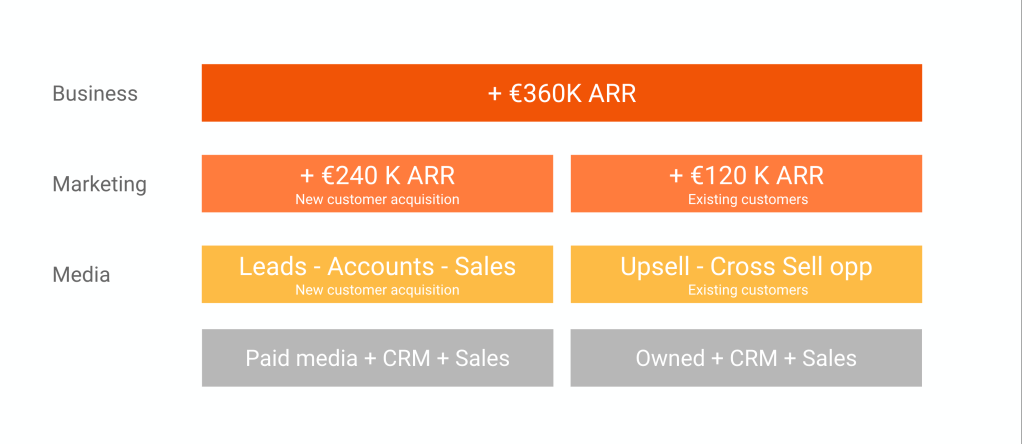
First, we will look at how much revenue we can generate from existing customers by upselling or cross-selling products. Generally, this is the most cost-effective and we do this through channels like CRM or account managers. Existing customers are a limited source of growth so the remaining growth should be generated by acquiring new customers.
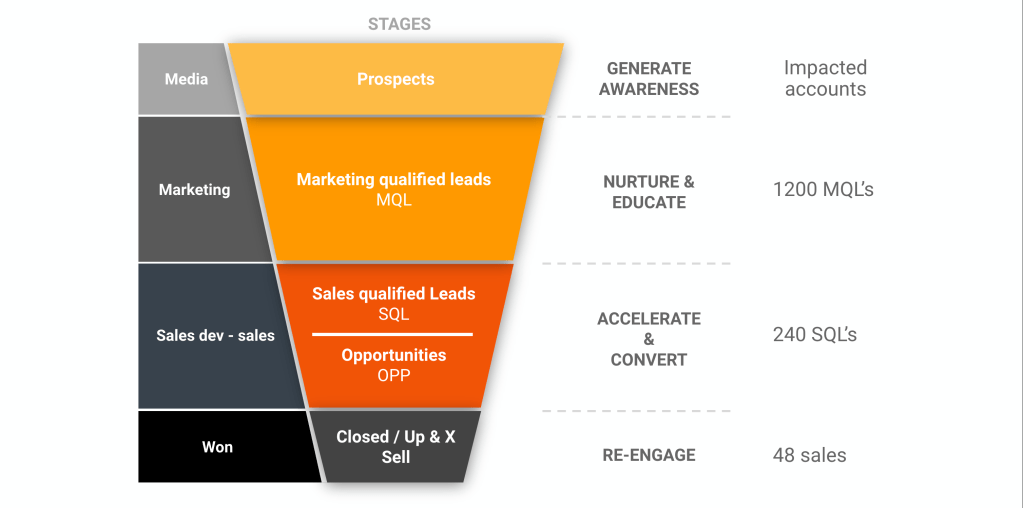
We look at the acquisition of new customers in B2B as a funnel. If we have previous data we can be more precise in our calculations and lay out all the numbers in our forecast. B2B funnels are typically structured with the following stages:
- Leads
- MQLs (Marketing qualified leads)
- SQLs (Sales qualified leads)
- Opportunities
- Sales
Each business will have a slightly different funnel and definition of stages.
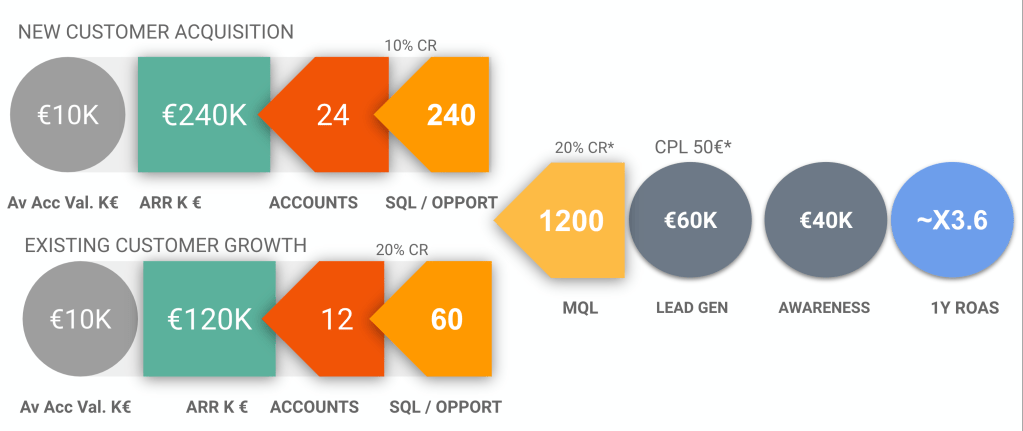
The last step of the exercise is reverse engineering the whole process and having some key figures for our calculations:
- Average value per account/customer
- Average cost per lead
- Conversion rates at each stage of the funnel
The output of this framework will be a budget and a ROAS you can achieve. You can use my own Excel template to make your own calculations.
Download the free template
It is common to draft different potential scenarios that can help the business decide on the level of investment Vs ROAS that they want to achieve in sync with the goals they want to set for the different marketing and sales teams in the organisation.
The benefit of doing the bottom-up approach is that it can be used as a way to gather insights on the initiatives required to help the business grow. Generally, a forecast will have a set of marketing initiatives, new product launches associated with it.
As business grow forecasting can become incredibly complex. But I hope this framework will help you get started with some of the basics.
I hope you find this useful. Is this the method you are using to forecast growth? Do you know any other methods? Let me know in the comments below.
 Cristian 360