
After many years of working with entrepreneurs, startups and large brands I have identified some patterns in marketing activities that will be crucial at each stage of growth.
Most entrepreneurs lack the experience to identify what initiatives they have to focus and will help them maximise their chances of success. They might have references of brands they admire and be inspired by marketing campaigns that might be out of reach at the level of their business or missing opportunities by lack of knowledge. Being able to allocate resources to the right initiatives at the right time is key, especially at the early stages of growth when resources are limited.
Growth it’s usually not a linear path and there are many ways we can drive a business to success and failure, there’s no recipe but generally there’s guidance we can use.
If you are interested in knowing what might be your best opportunity for growth with your startup or business through this journey of growth, continue reading you might find some interesting ideas.
Startup development phases
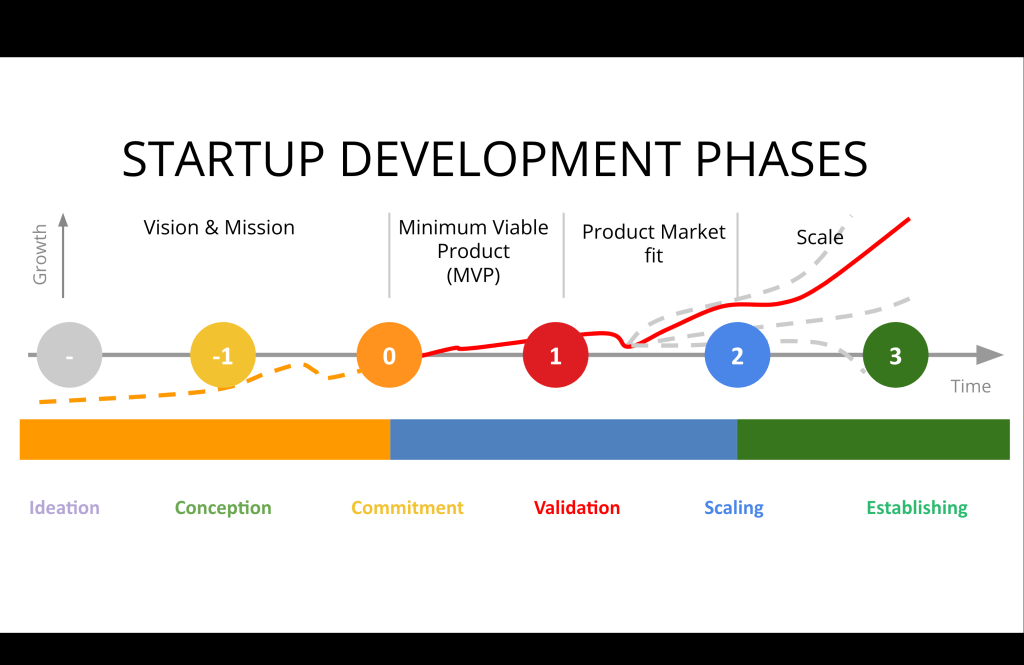
You can look at growth from many different dimensions but the above puts together 2 main variables, time and growth. Growth can be seen as customers (acquired & retained) or revenue.
Ideation stage
This is the starting point of the journey, focusing on the idea, finding the team and building a product. Developing a vision of your business ambitions, delimiting the audience you want to serve and developing mission/problem you are trying to solve, these are prerequisites before you even start looking at investing in any marketing initiatives.
If you want to dream big, put your ambitions to the test and access funding you’ll find very helpful guidance on how to tackle these steps reading from YCombinator’s funding round stages guide. You can also learn from SVB perspective on their initial stages of growth and what are the prerequisites of setting up a business.
Conception stage
At the conception stage you will work with the founders on the strategy. You will likely start thinking about the name you want to put to your business. You might register the business name and entity.
You will do most of your strategy identifying customer personas, sementing your audience and narrowing the demographics and geographics.
You will work on your business plan, identify the size of your market (TAM & SAM) and define a business model, having a loose understanding of the costs and the revenue you will have.
At this stage you will probably start defining elements of your product or service. From a marketing perspective you will start making your first investments by defining your visual identity and brand. It is a good time to start with brand registration and domain registration. Most funders will do this first steps themselves.
Commitment stage
You will be investing resources on building a product and as you do so you will need a platform to present it. This is usually done through a website. With so many free tools and free templates available many entrepreneurs will do this themselves but they might rely on professionals who can do this for them.
In this stage the business will try to find product market fit and be ready to pivot and do adjustments to the product and marketing materials to achieve this. Here is the step where having a testing culture is very important. Being able to set feedback loops is essential. Having a good structural connection between marketing, sales and product is key.
Depending on the size of the market and target audience you might be resourcing different marketing initiatives.
There will be the need to build a funnel or pipeline and to do so you can start doing this in an organic manner, SEO can play a role, by building partnerships, listing your business in relevant sites, if you are innovative enough you might be able to generate some PR, generate the first sales by presenting the product to specific companies at a discounted price so you can gather their feedback.
Validation stage
If everything is going well this is a crucial stage in your business and marketing will have a very big impact. You’re probably expanding your marketing capabilities have a more robust marketing strategy and plan. You will allocate more resources on trying to understand your customers and also on producing more content that is relevant to them.
You will be able to use more consistetly PR efforts due to the success of the business and more if your product is innovative.
At this stage you’ve probably generated some revenue and are looking on broadening the channels that you advertise.
You will start resourcing the team or using more external agencies to support with different needs such as: design, copywritting, website building, digital advertising, events and social media management.
You will start investing in a CRM that you can use to automate processes and for the nurturing of prospects and onboarding of customers.
You will invest in the development of marketing materials for sales teams with the support of product marketing with testimonials and strategic messaging that can highlight your competitive advantatges.
You will also start looking at ways to measure the effectiveness of the activities you run the traffic you are generating to your website. You will start investing more in things that work and trying to make the business sustainable.
If you are successful you might be able to take your business to the next stage and start scaling.
Scaling stage
You have proved that your business model works and generally have been able to reinvest most of the revenue generated. You are also able to proove to investors that you can conquer new markets and scale your idea.
In some instances founders might exit or continue to support the growth.
In marketing terms you will use a significant part of the budget to scale up operations there will be a significant part of the budget allocated to translation, and localisation, in ocasions having to hire in the markets where you want to expand.
You will invest in marketing activities that are scalable such as paid media / digital advertising, events, referral programs and affiliate marketing.
You will start using playbooks to gather best practices that can be shared across the organisation. You will invest more in retaining, upselling and crosselling to existing customers with new products.
Being data driven and by defining a measuring framework and developing the analytics and insights capabilities will become very important to justify the investment. You will start using attribution modelling to assess performance of all the activities you run.
You will implement sophisticated technologies and integrations of data across all your systems (Web, CRM, media channels). Data will be essential to assure you’re maximising your sustainalbe expansion efforts Make use of predictive modeling, Machine learning and Artificial intelligence.
Long term
If you have reached this stage by this time you probably own a significant part of the market and you will focus your efforts on consolidating and mantaining market share and becoming a top of mind brand. Making use of loyalty programs, and investing more heavily in advertising will take place. Starting to look at sophisticated growth modeling tools such as MMM (Media Mix Modelling). Large business will externalize many of their marketing capabilities and resource to external agencies becoming only governors.
 Cristian 360