
People in marketing departments always face the conundrum of figuring out what projects or initiatives they should focus on. No marketing department has an unlimited budget or human capital resources to do all they need to succeed or meet business goals.
Working strategically is crucial in assuring that time and effort are allocated effectively. As we know any approach to strategy should be data-driven and based on market and customer insights. But in some cases, you might already have the data. Still, you know there are other highly influencing factors such as opportunities, limitations, dependencies, or even relationships you’ve developed that will heavily influence what you can really do in the upcoming months.
If you’d want to find a way to develop a solid marketing plan where you, your team and other members will feel involved and reassured it’s the way forward. If you want to do this in a simple way and in a short session, continue reading. I’ve used this on several occasions, providing clear direction, alignment, and certainty on the priorities to focus on.
The ingredients of the workshop
What are the ingredients for the recipe or what materials do you need for the session:
- 1 Presentation or PowerPoint. To guide the audience through.
- 1 block of post-it or notes (square coloured sticky notes
- A meeting room with a centre table, round or square is the best setup
- A big screen or a projector (Is very helpful)
- The most important, the participants
The steps to a successful workshop
When you set up the meeting invite everyone to sit around the table. Have your materials ready to start the workshop.
Introduction to the session
A good session will always give time for a short introduction. If you are leading the session you can do this yourselves. It is courteous to keep time for introductions if members have to met before.
It is helpful to provide context to the participants. To do so make sure you cover the following during the introduction of this session:
- Purpose
Make sure people understand why this workshop is happening. For example: Identify what are the biggest opportunities for us to pursue and help us understand what we can achieve in the following months together.
- Process
Let them know how this will happen. For example, a brainstorming session will identify issues and topics to help us achieve the business goals.
- Outcome
Here you have to define what you’re hoping to come out with. For example: Bring alignment on the priorities and opportunities that we should focus on fostering growth for the business.
Remind everyone what the business goals are
A good starting point for this session is assuring you have clear common goals and direction, even better if these are set at a high level. There are many ways to do this. Some businesses use OKRs just to put an example (Objectives and Key Results).
Probably everyone is familiar with them, but it’s good to do a quick reminder. Present these in a PowerPoint to ensure everyone can follow and maintain their focus and attention.
Give them the power to decide what are the priorities and blockers
The time has come to distribute the post-it or note block papers. Ask them the following question:
“What can we do more of, start and stop doing that will support meeting our goals?”
Give them some examples to make this easier for them to understand and ask them to write each one on a post-it note.
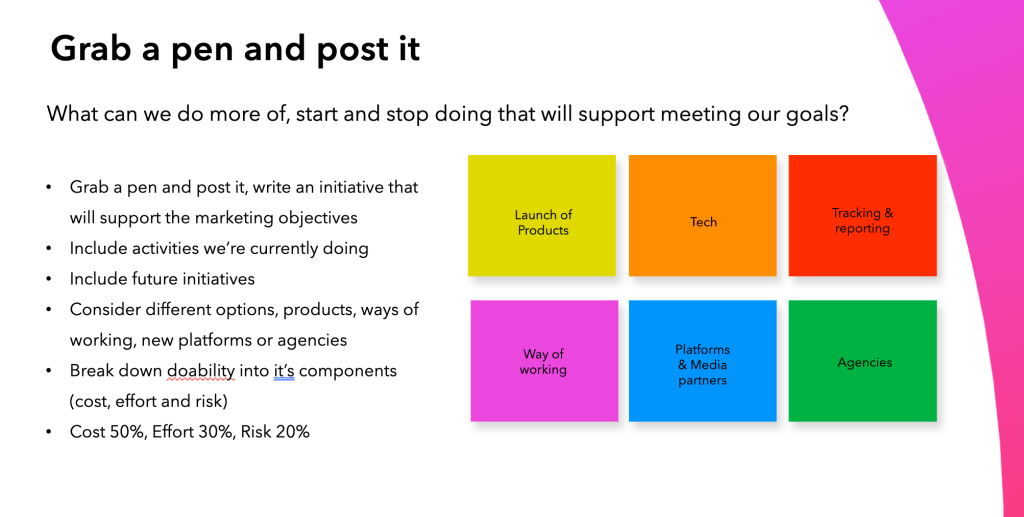
Give all the members at least 5 to 10 minutes to think about it and write it on the post-it notes.
The next step is helpful if you have a projector or a big screen. Ask each team member to think about the impact and the doability of the items they have written on the notes. Try to allocate these notes on the diagram below based on these factors.

You as the facilitator can stand up and go one by one of the items on the notes and discuss with the team how they think where each item would sit in the matrix. It is a good time to debate and consider each item relative to the other. This is the most valuable part of the whole workshop. You want people to be participative.
Once you have laid out all your notes, the next step is overlaying what each quadrant represents in the prioritization matrix.

Surprisingly, with this framework, you will see how all the initiatives and ideas that came out have a purpose and a step to follow.
If you can overlay these on a screen or projector, it will help you and others visualise what the actions and outcomes from the session are. What this could look like is the following:

Taking a picture of the screen or table with the matrix and notes in order is important as this is the session’s outcome. The next step is simple, summarizing these in a plan with timelines. As per the example below.

Now with this, you have been able to do in a short session a very powerful exercise. Reducing friction on finding out what the priorities are and bringing consensus by providing the reasons why some actions have to be scheduled first Vs others that might require more time, remain in the backlog or just delegate to others.
That’s it; you are now ready to prepare for your next prioritization session and help you and your team understand what you have to focus on.
Let me know in the comments below if you have done a similar session or you are using other methods.
 Cristian 360