
Today’s customers expect a seamless experience with the business both offline and online, they want a consistent experience across all touch-points and every time they interact with a brand. This is from watching an ad to interacting with a post sales representative.
Achieving this is a challenge for any organisation and requires creating the frameworks, adjusting the systems and setting up the technology to monitor user behaviour. The ultimate goal will be to use this information to understand better our audience and set up the strategy to influence and provide a better experience.
The first step would be to map out the customer journey and have a deep understanding of who our customers are. We have a diverse set of tools available that should help us identify and segment who these are:
- Interviews
- Survey
- Meetings
- Customer service calls
- 3rd party data reports
We can also use quantitative data to assess what is the kind of audience and their behaviours, a very simple and quick way to do this is by using Google Keyword planner.
I will use an example on how we can optimise the experience and user journey of someone who is thinking about getting a new TV. I had recently presented a user journey optimisation plan for Samsung TV with their retailers in UK. I believe this is a really good example to illustrate the process.

We can use Google keyword planner as a tool that gives us information about the intent but also about what is the volume of users at each stage of the funnel.
This will help us assess and decide how and when we want to influence these users and what tests we can run.
As seen in the graph above, the biggest volume of users come from:
- Generic search (TV)
- Price related (Cheap)
- Brand affinity (LG, Samsung, etc)
We could come to the conclusion that these 3 parameters are key in the decision making process of buying this product.
Another key factor would be to understand what are the products that Samsung is selling and how they compare to the competition.

As seen in the graph above LG is the biggest competitor with a bigger range of products. Being Samsung the brand that indexes higher than any other in the high end expensive range.
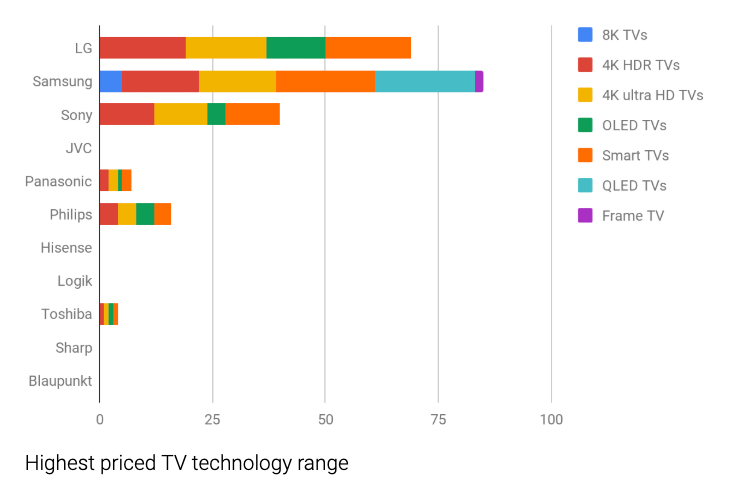
Fortunately Samsung is an innovative brand that will try to compete with technology, which is a more profitable and viable way than competing on price. We can use this as a competitive advantage and main selling point. The main selling points for Samsungs product market strategy are:
- High end quality
- Latest exclusive technology
Back to user journey optimisation, we want to understand who is our target audience by building a demographic, psychographic and behavioural profile/persona.
This will be a representation of the users who would be our target audience. (If you are interested in knowing more ways to segment, target and position, read my article about STP framework)

We can use the information from our investigation through Google tools but also from the interviews and research to build a profile. We could further refine and segment this into other subsegments that would fall in other stages of the funnel and with different behaviours, this could be: considered brand purchase (someone who is sensible about the brand) or distressed/impulsive purchase (Someone who is in a rush). They would all have different behaviours. I will try to focus on the more generic and broad segment.
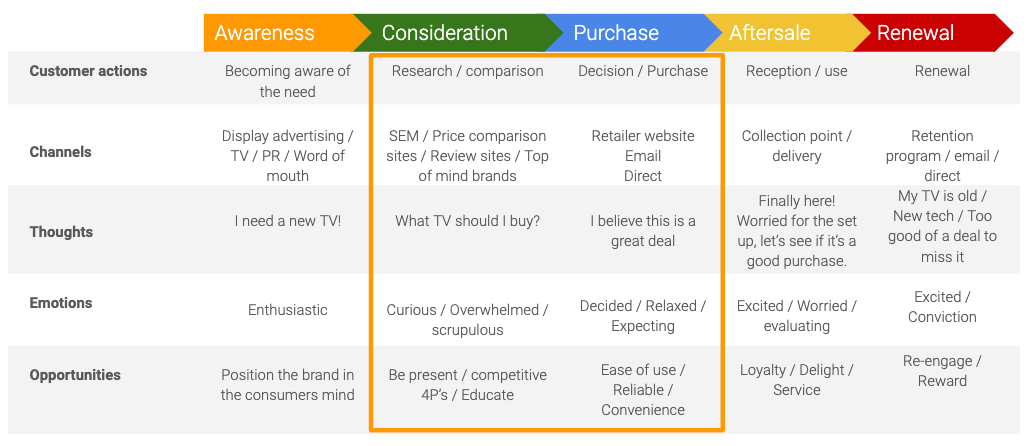
The next step in this exercise would be to map out each of the stages where our target audience would go through in their journey to purchase. Identifying what are the actions they take at each stage, what are the channels that we can use to influence these users, what are the thoughts that the audience have, their emotions and the opportunities that we have to influence them.
For the purpose of this exercise where we’re trying to improve the retail experience I will be focusing on the opportunities to leverage at the consideration and conversion stages. As these are the stages where a retailer has more influence on the consumer.
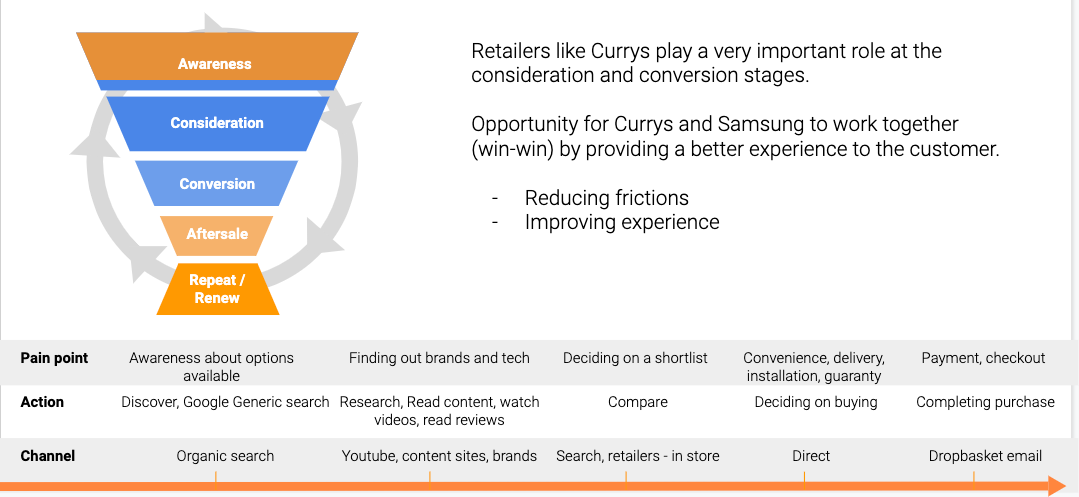
We can be more specific and map out what are each one of the steps, actions, channels that we can interact and pain points that our target audience might go through their journey. This will give us more insights on what are the hypothesis that we can formulate to run tests and improve their experience to influence their actions towards purchasing a Samsung TV.
Now is the time to be creative and come up with testing ideas and build a backlog that will prioritize tests based on opportunity and effort. This ideas have to be framed into the context where every one of them have to be focused on increasing the number of high end exclusive Samsung range products are sold.
Some examples of tests that we could run for this case are:
Awareness stage
- Improve brand awareness and educate: by funding display retargeting (Samsung – retailer).
- Provide a personalized experience: Incentivise log in of users at retailer site to provide product recommendations based on previous behaviours.
Consideration stage
- Reduce decision time – Smart quick filters (Test new filters that will increase the chances of finding high end products based on the combination of interests (Latest technology at the best price)
- Guidance and expert advice: Reduce decision making time by providing more expert advice and guidance. (Visual representations)
Purchase stage
- Provide convenience at the conversion stage by suggesting complementary products that will increase the value of the purchase. (bundle deals)
- Facilitate payment at the checkout by providing flexible payment methods such as financing or even subscription models.
These are just a few examples of tests that could be run. Are there any other tests you would suggest? Is there any other data (qualitative or quantitative) you would look at to make decisions? Let me know in the comments below.
 Cristian 360
One thought on “The user journey map, identifying touch points to influence and optimise the customer experience.”