
When working in an organisation where growth has happened organically teams find themselves innovating and testing new channels, in some cases there are different professionals and teams working in silos without coordination and direction of how they should be structuring their efforts and measuring success. This is very important, as it is the way to provide direction and a framework in which teams can work.
I´ve seen so many organisations where each team will look at different sets of reports and attribution models, examples of this can be: Google Analytics reports, which is not a bad source of data but it’s limited to Google products, and will usually miss paid social channels such as Facebook, Email or other offline channels such as sales or offline activity.
Another common limitation of not having a consistent framework is that each channel will be using a different approach regarding the time they take into consideration (cookie length) for a conversion. Google advertising services are based on a 30 day cookie period, others like affiliate might be using 60 day cookie window.
Another common issue is finding different marketing professionals looking at different reports or overloading the resources of the data and analytics teams with repeated requests.
There is also the need from senior stakeholders to have an holistic view of the performance of all the marketing activity, being able to understand what are the channels that influence at each stage of the funnel and are driving performance for the business. What are the contributions of a newly activated channel or campaign launched.
With this guide I’d like to set the basis and introduction of how an organisation can structure their resources and set the vision for teams such as marketing, growth marketing, product analytics, marketing analytics to build an acquisition marketing measurement framework.
This framework will bring consistency in terms of data and reports that can then be used across the whole marketing organisation but are especially useful for strategic decisions.
The main focus of acquisition is on driving prospects to sales. We should look this as a journey that the marketing department has the responsibility to discover and influence.
A way to simplify this journey is by structuring it in 3 stages in a simple funnel
Funnel conversion tracking
We need a way to track the steps our audience is taking towards our end goal, we need to define, identify and set up these funnel stages. This could be for example: leads and conversions, or search product page, product page and checkout. This depends on the type of business, website and steps you want to measure. Some people like to use the AIDA framework (Awareness, interest, decision, action) but I think it’s more practical to use a simplified version in 3 stages:
- Awareness: when a user becomes aware of a need or a solution to their problem. (Reach-Impressions)
- Consideration: when a user looks and compares options that cover their need. (Engagement-CTR)
- Conversion: When a user covers their need. (Conversion-CR)
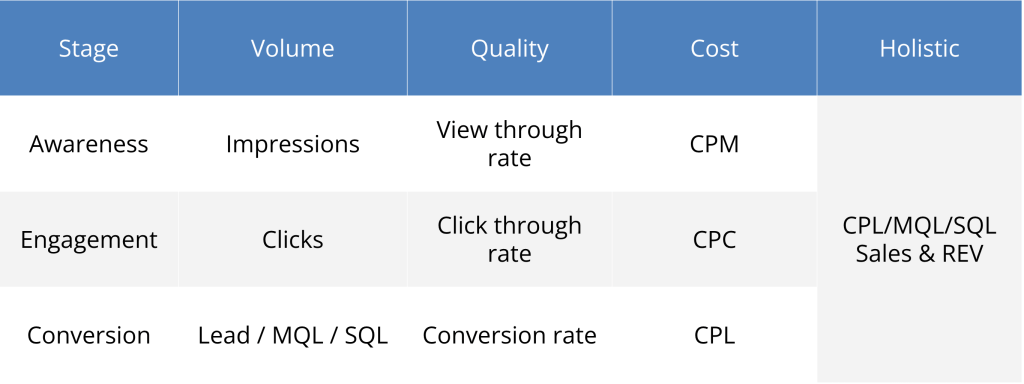
In the above example, you can see summarised a measurement framework for a B2B business that takes into consideration the 3 stages of the journey and criteria such as volume quality and cost.
Reporting and attribution
To be able to make decisions we need high quality real time assuring that all sources of data are standardised and organised in a way that can be stored in a centralised space and contain the 3 main metrics everyone will be interested in which are: performance, cost and revenue.
- Performance metrics such as impressions will come from all marketing channels and the same website. We can also integrate other systems like CRM or Salesforce to feed in data from email or sales calls.
- Cost, so we can measure what is the spend that each campaign is generating and how much we are paying to acquire a new customer.
- Revenue and LTV, so that we can understand what is the revenue earned for a conversion and what is the value of a new customer acquired.
These set the basis for us to calculate basic metrics such as ROAS (Retun on ad spend), ROI Return of investment) or LTV (Life time value).
If you’ve got to this point and want to take things to the next level, you might be interested in knowing more about multichannel attribution, continue reading more about this topic reading the following article.
 Cristian 360
One thought on “Acquisition marketing measurement framework”