
What is multi-touch attribution?
It has different meanings for different marketers but in essence, it would be the science that would help us understand what the journey is and how we attribute value to each of the channels in our marketing efforts.
For example, any marketer will look at the steps that someone will take to buy a product. This can traditionally be summarized in:
- Search for the product
- Visit the site
- Purchase, convert
For simplicity, I will be using Google Analytics reports as these are widely recognised and used across industries.
Let’s have a look at the Google Analytics report Acquisition metrics by channel, which shows this:
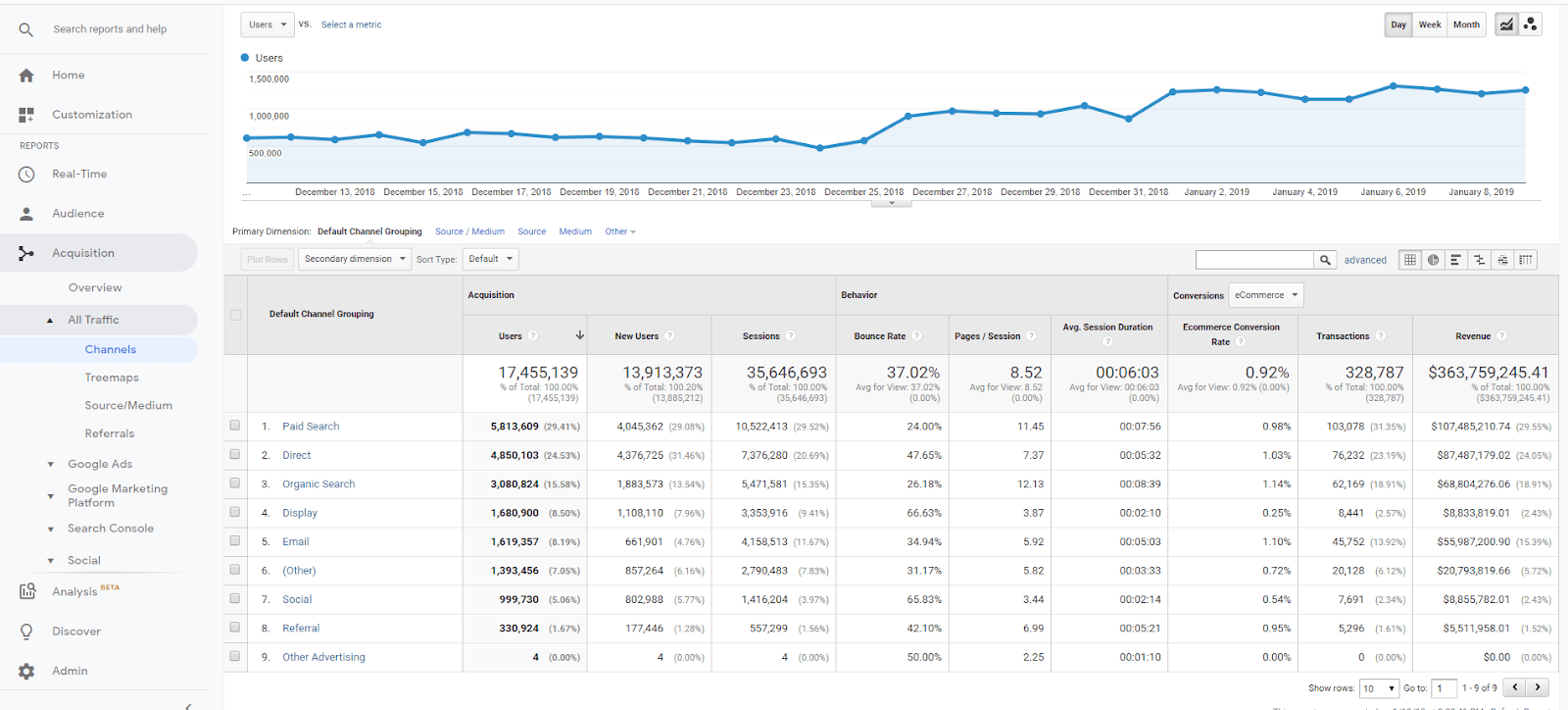
We can see a list of channels and it’s performance, cost and revenue provided.
We can also easily look at conversion by campaign:
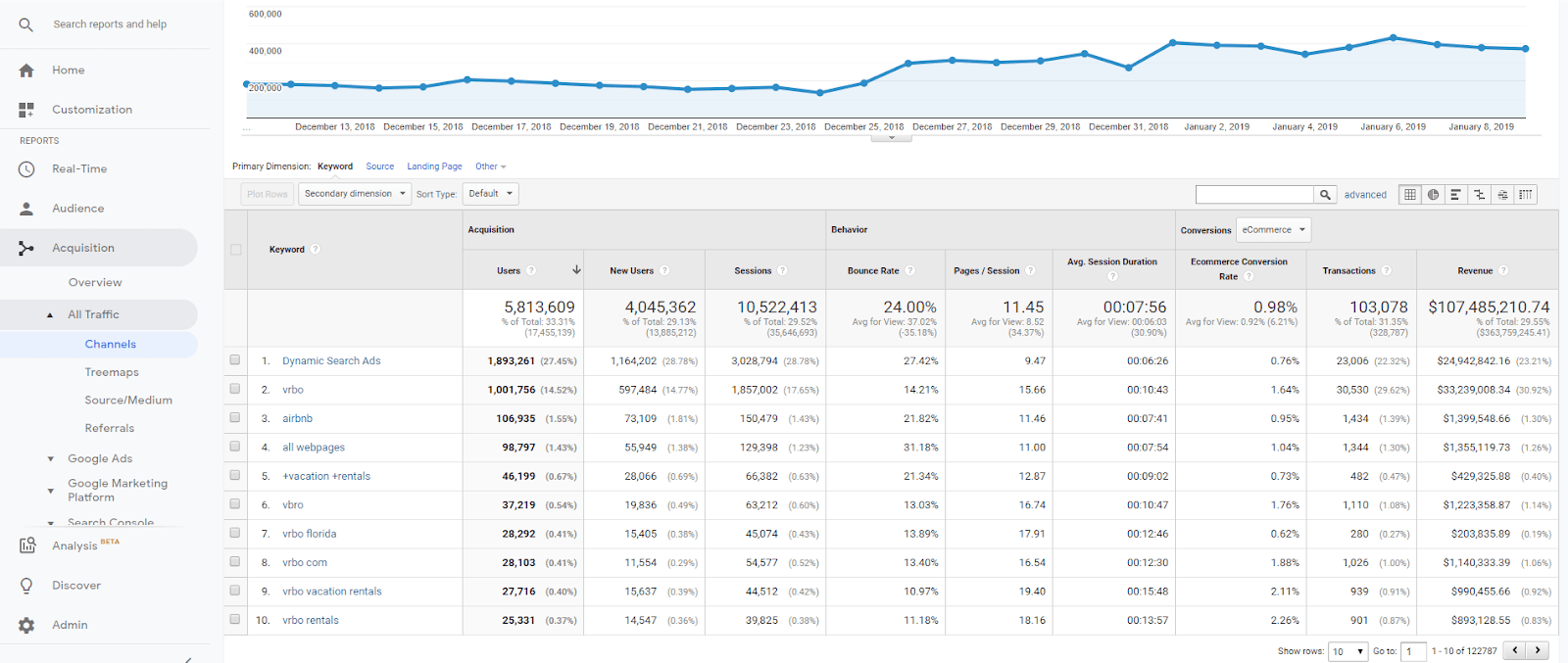
We can see in both reports metrics such as users, transactions and revenue which gives us crucial information about the performance of the channels and campaigns itself. Generally, it can be easy to make assumptions, and interpret the data in a simplistic way or default configuration (Last click). This is a common way to look at reports, but it is also limiting our opportunities to understand how far media investment can take a business for growth.
Let’s take one step back and think about what will a user journey look like from a media perspective. Users don’t convert at the same moment they see an advert or visit a site. There’s a process that leads to a conversion, let’s have a look at the following example:
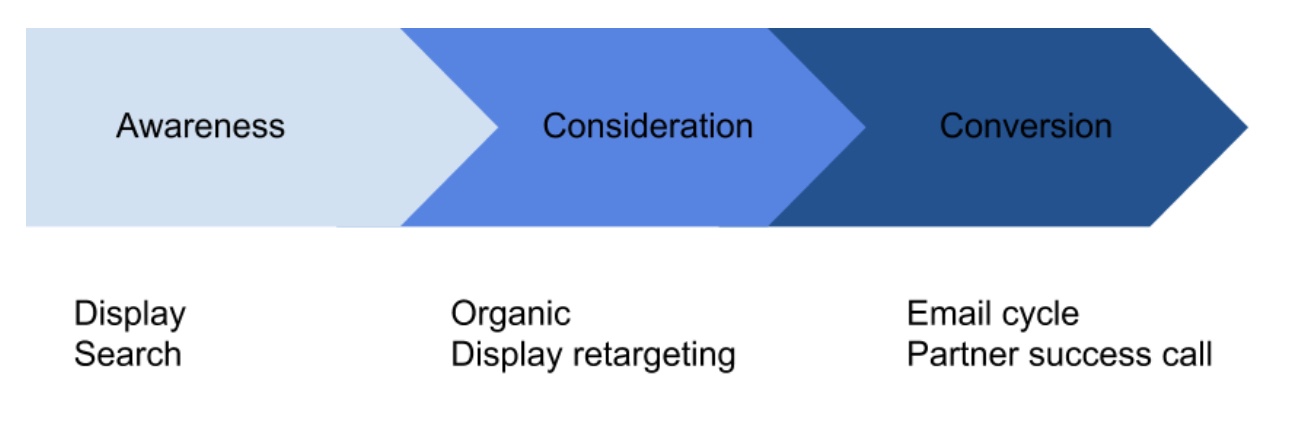
One day someone sees an ad that makes them aware of the product or service (Display-paid search-Awareness).
Later that day, they might come to the site to explore the product offering (Display retargeting-Organic-consideration). They might Think about looking for alternatives and research the product with other competitors. But just before leaving, they will leave their email to secure a first-time buyer discount.
Later that same week, they received an email with a reminder of low stock. If they make the decision to buy or sign up, they will come back and buy the product (email-cycle-conversion).
This is an example of the process that people might follow, from awareness to conversion. It is important to understand that some users might take different times to go from awareness to conversion.
It is important to understand that a promotional email converted a user down the funnel, but it is the result of all the other marketing activity that has happened before and that has fulfilled the 2 previous stages of awareness and consideration.
A way to illustrate what kind of channels we can work with is looking at categorising marketing channels that will do a good job at each of the stages of the user journey:
- Prospecting channels
- Conversion channels
There’s an important relationship between how these 2 type of channels work together to bring conversions for the business.
Think about it as if this was teamwork like in a football team, there are the scorers but there are also the players who fight to get the ball up to the front player to score.
It is crucial for the role and good game of the assisting players to bring this ball to the front. It is crucial for the role and good game of the assisting players to bring this ball to the front.
Reporting will be key in helping us understand the role of each channel in driving users down the funnel.
Why is attribution important?
Marketing analytics is such an important area of Marketing, why is it?
Most businesses are increasingly investing in business analytics, this can even represent 30% of the marketing budget. This is due to the understanding that conventional methods of measurement are incomplete, slow and generally suboptimal. When we use multitouch attribution models, marketing leaders can use the insights as a competitive advantage against competitors.
Some research shows that those who invest in marketing analytics are growing faster, and more profitably.
What are the benefits of Attribution:
We can use multitouch attribution modelling to answer many usual marketing questions such as:
- How much revenue did Paid search drive this week?
- What are the most profitable channels?
- Which creatives have been more effective?
We can segment the data also to know:
- What are the geographies that drove more traffic on paid search this week?
- What is the device from which users are browsing
- We can look at it from the product segments perspective
We can look at the data by analyzing what channels were delivering performance in each of the stages of the funnel:
- Early in the funnel
- Bottom of the funnel
- We can understand the user journey a bit better
We can also look beyond the aggregated channels so we can look for example at:
- What is the role of non-branded search?
- What are the effects of display frequency, do they vary across different types of media?
- Are certain types of ads more effective during different times of day or days of the week?
- Which creative copy works best and has the most impact?
- Does sequential targeting of ads perform better?
And now, why don’t you share with me what are the questions you’d like to answer with attribution modelling, what are the data challenges that you are facing to understand better your investments and make decisions? Please share them in the comments.
What to learn more about attribution modelling, learn about last-click attribution model and what this model can help us understand from our marketing activity.
 Cristian 360
5 thoughts on “What is multitouch attribution modeling for marketing”