
I had been sitting on the couch the other Sunday eating pizza and a thought came to my mind, how did I get to do this?
I tried to analyze all the process from the most basic motivation to the decision of ordering it. I found out that there had been a few things that had influenced this process.

When researching about human behaviour and decision making I discovered a few studies that can answer the sequence events that took me to the decision of buying pizza, some of these can be summarized in human needs/motivations, perception, and behavior/decisions;
Motivations + Perceptions = Behaviours/decisions that can lead to actions
I find these topics very interesting as my professional background working in marketing incentivises me to find ways to better understand the behavior of the consumer and find ways to influence them to buy a product. I try to understand what are the motivations and frictions that users have when trying to make a decision or action. By understanding how these mecanismes or relations work I might be able to create a better marketing campaign.
Hierarchy of basic needs
To understand where this action of eating pizza originated it is good to start by the basic principles of knowing what Maslow’s identified as the hierarchy of basic needs. This hierarchy helps to identify and organize what are the basis or universal needs of people regardless of any culture or place of birth.
These were organized in 5 levels, starting from most basic to more sophisticated. These could be organised as a pyramid where every human being will try to cover from the base to the top to reach a status of self-fulfillment. In most cases, it is a natural unconscious behaviour, the search to fulfill the needs in this order.
The 5 levels can be summarized in:
- LEVEL 1: Physical Survival Needs
- LEVEL 2: Physical Safety Needs
- LEVEL 3: Love and Belonging Needs
- LEVEL 4: Self-esteem Needs
- LEVEL 5: Self-fulfilled (Self-actualised)
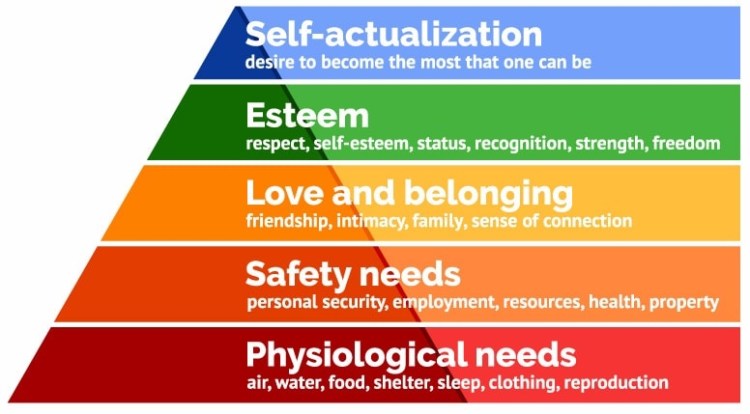
It is surprising how simple it is to summarize all our needs, but how hard it feels in life to have a sense of fulfilment, as we are always looking for ways to improve our lives.
When we identify a need, let’s say I am hungry, I will then interact with my environment to pick my phone and order a pizza, I will probably use my sight to pick up the phone from the table.
There’s a way or universal language we all unconsciously use to make sense of what surrounds us. This language or how we read and interpret the visual environment (perception) has been an area of study by many Psychologists. One of the first schools of science to study and organise these perceptions was the Gestalt.
6 principles of perception
The Gestalt movement originated from the Berlin School of experimental psychology. The Gestalt studied for many years human perception and tried to understand how humans create meaningful perceptions from an apparently chaotic world. They summarised their whole study in 6 principles.
These principles or laws are:
- Law of Similarity
- Law of Pragnanz
- Law of Proximity
- Law of Continuity
- Law of Closure
- The Law of Common Region
There are many applications of these principles used by different industries such as design, architecture, cinema or advertising. They use this knowledge to facilitate the interactions with any user, or they might even use them to manipulate.
Going back to the example I mentioned earlier, I am hungry (LEVEL 1: Physical Survival Needs), I perceive my phone on the table (Law of Pragnanz), I pick it up, I remember about that pizza limited time discount I saw advertised the other day (Behavioural economics). I decide to order.
This rational last step that leads me to think about the discount where I have seen in an ad and rationalised the decision behaviour has been studied, and their findings organised as part of an area of study called behavioural economics.
Behavioural economics
Behavioral economics, this is the study of phycology as it relates to economic decision making processes of institutions and individuals. It is very important because understanding the causes that influence human behavior helps to understand better the decision-making process.
This studies have been organised in principles:
– The overconfident effect
– Temporal discounting
– Loss aversion
– Anchoring and framing
– Social norms
– The peak-end rule
These have been the findings of my research about the origin of a need to the decision of making an action. I hope you have found them interesting. We live in a very complex reality and there are probably many other factors that could influence people’s actions. If you know of any, why not share them in the comments below?
 Cristian 360